
Doluca Family Endowed Chair in Electrical and Computer Engineering
UC Santa Barbara
Abstract: With the RF bands below 5 GHz soon to be exhausted, industry is poised to move to 5G systems, with carriers at 28, 38, 57-71 (WiGig), and 71-86 GHz. Research now explores the next generation of wireless systems, those operating between 100-1000 GHz. Such systems can support massive spatial multiplexing in both endpoint and backhaul links, and will require high-frequency transistors in VLSI and in III-V technologies, phased-array transceiver front-ends, and complex silicon RF ICs to form and aim multiple beams and to null or equalize multipath interference. We will summarize THz transistor design, IC development from 100-1000 GHz, and array and system design.
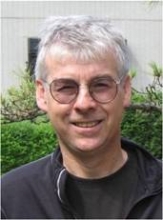
Bio: Mark Rodwell (Ph.D. Stanford University 1988) holds the Doluca Family Endowed Chair in Electrical and Computer Engineering at UCSB. He directs the SRC/DARPA Research Center for THz Communications and Sensing, and manages the UCSB Nanofabrication Lab. His research group develops nm and THz transistors, and millimeter-wave and sub-mm-wave integrated circuits. The work of his group and collaborators has been recognized by the 2010 IEEE Sarnoff Award, the 2012 IEEE Marconi Prize Paper Award, the 1997 IEEE Microwave Prize, the 1998 European Microwave Conference Microwave Prize, and the 2009 IEEE IPRM Conference Award.
