
Creating Materials that Change Color and Temperature
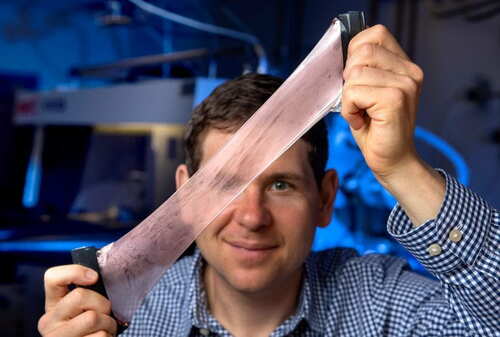
Jan. 20 , 2026 – A coat that adjusts its temperature with the climate. Military camouflage fatigue that changes colors to blend into its surroundings. These are just some of the smart fabrics Alon Gorodetsky envisions can be possible as he unlocks the secrets of how cephalopods change with their environment.
A video of an octopus popping out of an algae-covered rock presented by his current collaborator Roger Hanlon inspired his research. Gorodetsky walked out of that seminar deciding to study just how those creatures do that. “It was much cooler than anything I was planning on doing. They have this amazing ability to emulate almost anything in terms of color and texture and shape,” said Gorodetsky, UCI associate professor of chemical and biomolecular engineering. “It's just something that you might only see in ‘The Terminator’ or one of the X-Men movies.”
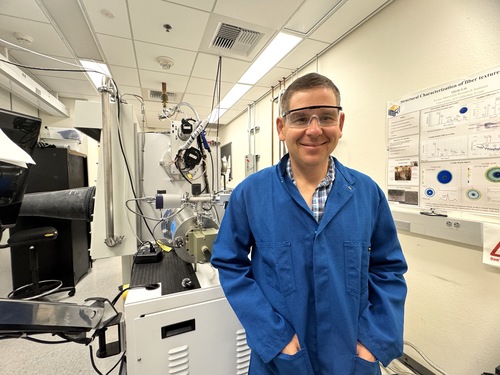
Gorodetsky’s lab has been on the forefront of creating materials inspired by cephalopods. His lab has looked to squid skin as a model to make a novel material that can change color and regulate the flow of heat. They program the nanostructure and microstructure of their material with an electron beam evaporation system that mimics the structure of squid skin cells.
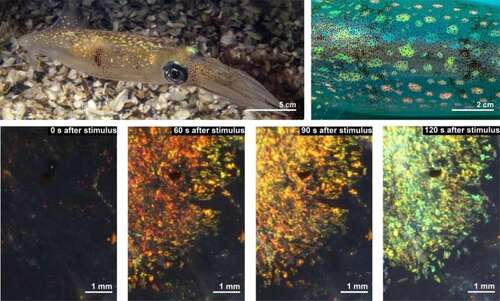
They’ve found that squids have cells called iridophores that contain stacked and winding columns of platelets from a protein aptly called reflectin. Reflectin transmits and reflects light at various wavelengths. In a paper published in Science, Gorodetsky explained how they imitated the internal columnar structures of the cells to develop a material that can change its color, transparency and infrared properties.
“We experimentally and computationally demonstrated that iridescent cells (iridophores) containing Bragg reflectors with sinusoidal-wave refractive index profiles enable squid dorsal mantle tissues to reversibly transition between nearly transparent and vibrantly colored states,” Gorodetsky said in his paper. They drew inspiration from those discoveries and prior work on squid chromatophores to design their materials. The technology has potential to be used for camouflage, heat management, display and sensing applications. Gorodetsky was named the 2021 Director’s New Innovator by the National Institutes of Health for his innovative research.
Among many of his lab’s creations is a material that can be used as a wrap around a coffee cup to regulate the drink’s temperature to a desired state. The innovation is detailed in a study published in Nature Communications. “Ultra-lightweight space blankets have been around for decades – you see marathon runners wrapping themselves in them to prevent the loss of body heat after a race – but the key drawback is that the material is static,” said Gorodetsky. “We’ve made a version with changeable properties so you can regulate how much heat is trapped or released.” Currently, his material is large enough to use as a sleeve over a cup of coffee to regulate its temperature. They are working to enlarge the material so that it can be wearable as a vest or jacket.
He ultimately aims to create smart fabrics that could be useful for medical, military and consumer applications. Clinical applications, he said, could include a device that keeps a patient at just the right temperature while they’re getting surgery. For the military, he envisions manufacturing camouflage fatigue that changes colors to blend in with the environment and even an unmanned vehicle that becomes invisible.
For consumers, he’d like to create material that can change temperature for the comfort of the person wearing it. “It could be a personalized heating or cooling system that adjusts to the surrounding climate,” he said. The lab has created a wearable sleeve that can change not only color and temperature but infrared transparency. They’ve integrated their materials with clothing and created a fabric that can be washed over twenty times. Now his lab is working on expanding the size of the material for larger applications, which he envisions could occur within a decade.
This work has been primarily supported by the Defense Advanced Research Projects Agency, the Air Force Office of Scientific Research , and the Advanced Research Projects Agency–Energy.
- Natalie Tso
