
Q&A: Rocket Propulsion Lead and Blue Origin Intern Uma Iyer

Jan. 15, 2026 - The UCI Rocket Project (Liquids) is one of the few undergraduate teams in America that has launched a rocket with cutting-edge methalox fuel. That rocket reached 9,300 feet in 2023. The team is preparing to launch their second methalox rocket named Moch4 this spring. Uma Iyer is a propulsion lead on the team and a mechanical engineering senior.
What do you do as propulsion lead for The UCI Rocket Project (Liquids)?
Each quarter we have a set of tasks geared to what we need for launch and we have a timeline. Our main goal is to encourage our members, give them requirements for design, test and manufacturing components and walk them through it and help them achieve their tasks. We're there to give them technical support and advice. I work with our chief engineer, and we basically oversee the entire test campaign.
What got you interested in rocketry?
I've always really been interested in chemistry and propulsion. I'm really interested in engines, fluid dynamics and thermodynamics and how all those classes that we take in those disciplines come to work in rockets. What really got me interested was seeing those physical concepts being applied to something super cool, like launching a rocket.
What did you do as a test engineer intern for Blue Origin last summer?
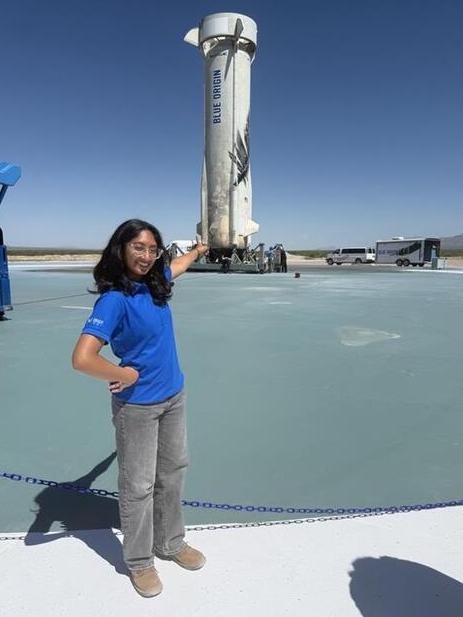
I worked at the site where they launched New Shepard but all the stuff I worked on was for their rocket New Glenn that was launched recently. It was a lot of sitting in the control room with different test directors and doing test operations for components on the New Shepard rocket and the New Glenn rocket. I did a lot of piping and instrumentation diagram redesign, ordering components, redesigning parts of our test stand and talking to technicians.
I think my favorite part was working with technicians, responsibility engineers, test engineers, and ground systems design engineers and getting insight from each of them and combining that knowledge together.
What do you think enabled you to land your Blue Origin internship?
I attended a conference where I got to visit the Blue Origin headquarters in Kent, WA. To be accepted to attend the conference, I had to write essays on my purpose for wanting to be an engineer which is to use my curiosity and passion for learning to help people. At the conference, I prioritized making connections and hearing various engineers’ stories of how they got into aerospace and what they love about it. A couple months later, I got a technical interview. I presented about my responsibilities as a cryogenic dewar operator and test stand ops personnel on the UCI Rocket Project. I was enthusiastic to apply fundamentals of science and engineering I learned in school to stressful test environments and that made the interviewers excited about me as a candidate! Ultimately, the UCI Rocket Project allowed me resources, an amazing team of super brilliant and dedicated engineers, and a collective passion for a mission to have experiences that happen in industry, which my recruiters equated to translatable experience for this internship role.
Why is the UCI Rocket Project Liquids taking on the most cutting-edge fuel, methalox?
We chose methalox because as students it’s important for us to work our way up to industry and that's what all these big new space companies use, like Space X and Blue Origin. And for the purposes of space exploration as well. So by getting our hands on cryogenics, we're basically adapting ourselves for the jobs that we'll be working on in the future.
UCI’s first methalox rocket Peter reached 9,300 feet above ground level and you want to go higher. What’s new about the second-generation rocket Moch4?
So compared to Peter, this rocket is much slimmer in diameter and conserving a lot of mass because you don't want your rocket to be too heavy. So that's a huge change that we've made to our system. It's more refined and compact. Peter wasn't able to be recovered successfully, but our launch vehicle team is working really hard to improve our recovery systems.
Why did you name the rocket Moch4 (pronounced mocha)?
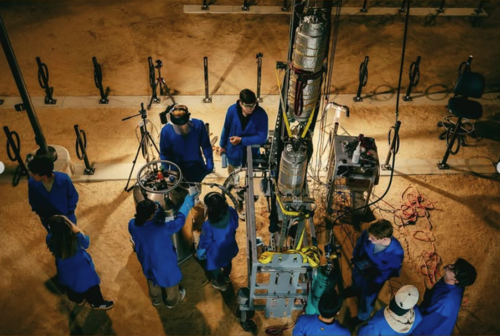
Everything is coffee themed because I guess we students are caffeine addicts. But if you break it down, it's like the M and the O for methane and oxygen. And CH₄ is the molecular formula for methane. Our test stand that our rocket is sitting on is called cold brew and the test area where we roll cold brew out to is called the cafe.
What’s the biggest challenge of working with methalox?
It’s a cryogenic fuel, which means that -160 to -180 is the Celsius boiling point of our real propellants. That's the point they start to vaporize and we start losing propellant so you have to keep it under that. It's just hard when we're out in the desert and the sun's beating down on us and the temperature of the air is way higher than the temperature of the propellant. That's why time is of the essence. So we chill, fill, pressurize our system and then immediately hot fire.
What do you like most about the team?
Our team is quite scrappy in the sense where if something fails, then we'll have all of us in a huddle, brainstorming for hours until we can get a solution and then we integrate into the system and test it.
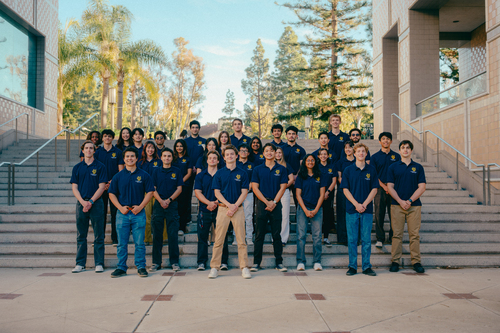
What this team has taught me is perseverance. If we have an issue, we're going to do whatever it takes to fix it. We’ll spend late nights here trying to fix it, of course trying to maintain a healthy work/life balance. That scrappiness — dealing with ambiguity, testing and trying to get the problem solved is what I love most about this team.
What do you love most about aerospace?
I like the fact that space has so many opportunities in the sense that you're never going to run out of things to learn. I think that in itself is really liberating. It's like you're never going to be stumped by Oh, what's next? because your curiosity is always going to be thriving.
- Natalie Tso
(Listen to a 6-minute podcast episode of The Lab Beat featuring Uma Iyer and other students on the UCI Rocket Project liquids team)
