
From Concept to CAREER Award
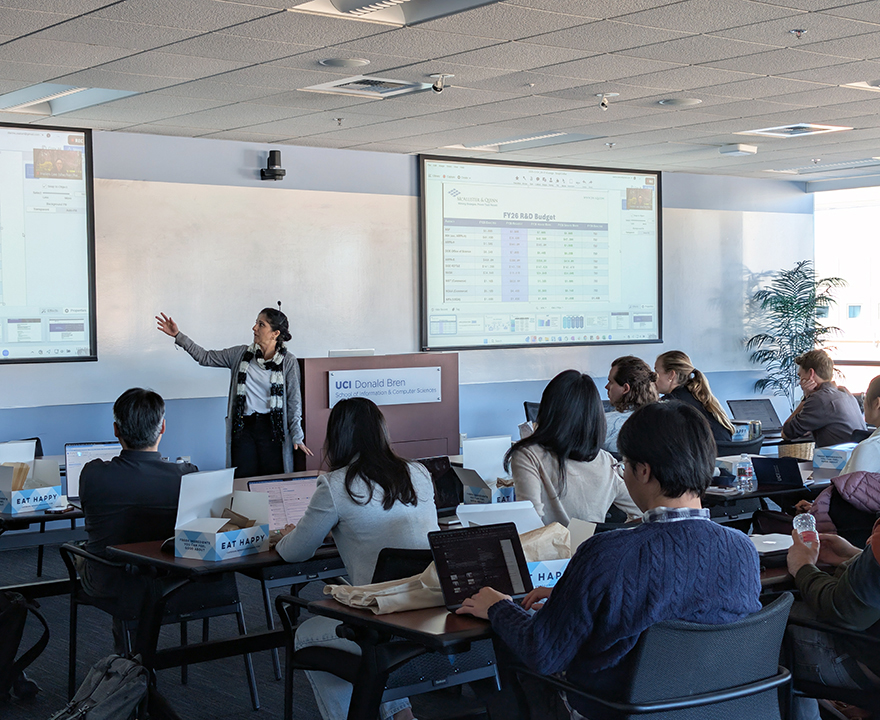
Since 2023, UCI’s NSF CAREER Institute has helped dozens of assistant professors navigate the complex federal grant proposal process, increasing access and success securing millions in research funding
Feb. 17, 2026 - Funding from the National Science Foundation plays an essential role at UC Irvine in advancing critical research spanning topics from brain health and AI to wildfire mitigation, water quality and shifting social dynamics. Securing this highly competitive funding, however, requires navigating a complex pathway – one that can be daunting for early career faculty members working to bring new research ideas from concept to award. With this in mind, UC Irvine launched the NSF CAREER Institute in 2023, aiming to strengthen proposal development and improve funding success for assistant professors applying to NSF’s Faculty Early Career Development Program (CAREER).
“While some professors have submitted grants as graduate students or postdocs, many have not,” says Melinda Gormley, an instructor and coordinator for UCI’s NSF CAREER Institute who also serves as the research and policy coordinator for UCI's Center for Population, Inequality and Policy. “UCI expects its faculty members to secure extramural funding to support their research, and it can be hard figuring out how to find funding that matches your project and how to write a competitive grant proposal. The NSF CAREER Institute helps break down and simplify this process.”
Joining Gormley in delivering effective programming for the institute are UCI research development directors Holly Hapke, social sciences; Darine Zaatari, information and computer sciences; Helen Lee, engineering; and Sydney Prange, physical sciences.
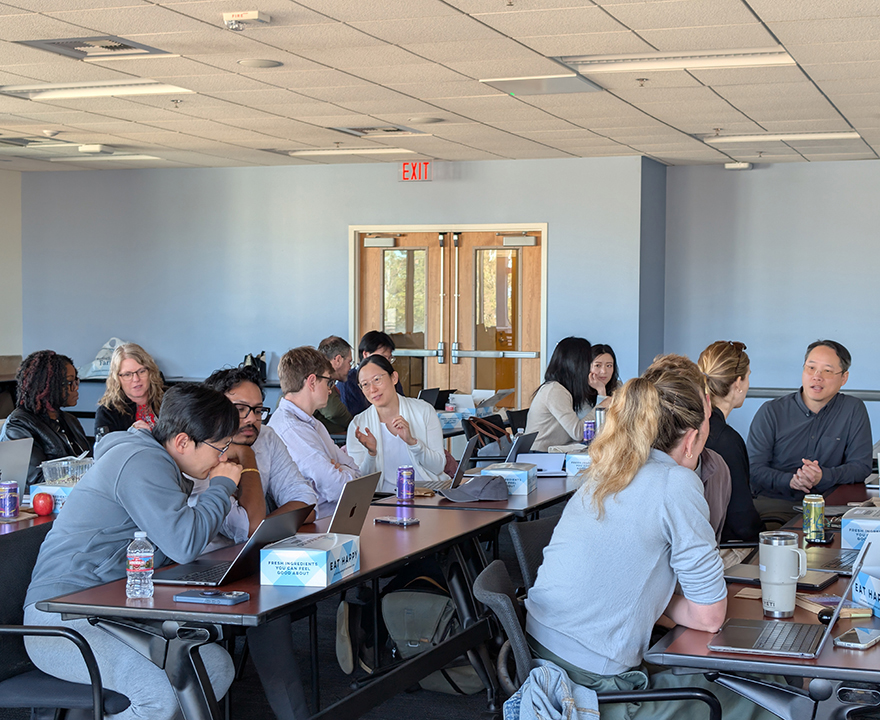
Together, they lead workshops throughout the year focused on tips for successful proposal writing. Additional faculty-led mentor sessions are hosted in smaller subsets where open discussion leads to valuable feedback and reviews of draft proposals. Institute participants can have their proposals reviewed by subject matter experts and use the feedback they receive to revise their proposals before NSF’s deadline. And the process is working.
To date, UCI’s institute has provided training and mentorship for 63 assistant professors, 40 of whom have submitted at least one CAREER proposal. From this group, 14 participants have received NSF CAREER awards so far totaling nearly $8.8 million (fiscal year 2025 submissions are still pending at NSF).
“We are still waiting for decisions on 2025 proposal submissions, but the success rate of institute participants in getting a CAREER grant so far has been about 46%, compared to about 22% of those who submit without participating,” says Hapke. “That’s a significant difference and demonstrates the positive impact formal training in grant proposal writing can have. What participants learn about writing NSF CAREER proposals will be relevant for other grant proposals they’ll submit across their entire academic career.”
This year’s cohort kicked off activities on January 27, welcoming 18 new and six returning participants, six mentors, and five instructional leads. Kristin Turney, sociology Dean’s Professor, is beginning her third year as a mentor with the institute, filling an important role in guiding scholars through proposal development while helping demystify the competitive CAREER award process.
“It's been invigorating to meet scholars across campus who are doing cutting-edge, creative, and ambitious research. It's fun to watch these projects develop and to see how the institute can foster community among early-career scholars,” she says. "The NSF CAREER Institute is invaluable for early-career faculty because it can help to bring transparency to what can seem like an opaque and high-stakes process. This is particularly important in the context of increasing uncertainty and volatility in the federal funding context."
For the participants, the opportunity to build community and engage in the entire proposal preparation process in a structured, supported way is a key selling point.
"The UCI NSF CAREER Institute provided critical information about the process, timeline, and level of review needed to submit a strong proposal,” says Christopher I. Olivares, civil & environmental engineering assistant professor and Water-Energy Nexus Center associate director. He was part of the institute’s original ’23 cohort. “The structure of the presentations, the coaching by a recent awardee, and the external review of proposal drafts helped me bring out the best of my work into the proposal.”
Upon completion of the yearlong program, he was successful in securing a $559,788 NSF CAREER award from NSF’s Division of Chemical, Bioengineering, Environmental and Transport Systems to further his research on water quality following fires.
“Funding from the CAREER program helped me build a solid foundation for my lab, especially in Ph.D. student training, and expand our work. This in turn allowed us to respond swiftly to the 2025 Palisades and Eaton Fires in Los Angeles,” he says. “Combining the education and research objectives we already had planned, we were able to provide timely information on drinking water quality for the affected communities, and we just submitted this work to a scientific journal.”
In particular, he notes the external review portion of the institute’s programming as being extremely helpful. “I received very critical feedback and I wouldn't have reached out to these people had it not been for the program and the structured review portion,” he says.
Elizabeth Bess, chemistry assistant professor who was also part of the ’23 cohort, agrees: “Feedback from anonymous reviewers in a mock-review style was a highlight of the program. Mock reviews helped better acquaint me with the review process and provided actionable feedback to improve my grant - all before it was submitted. The result of this rigorous pre-review was that my first NSF CAREER application was funded!” she says.
The award - $663,610 from NSF’s Division of Chemistry - enabled her lab to discover ways that lignin dietary fiber - which people eat every day - is digested by the trillions of bacteria that live in human intestines.
With the 2026 cohort underway, Gormley is hopeful that the program will see continued success and NSF support for important research happening on campus.
“The NSF CAREER program requires applicants to integrate research with education, and that’s a great model for our faculty here at UC Irvine,” she says. “We want scientists and engineers who are not only conducting cutting-edge research on pressing problems but are also quality educators shaping the next generation of scientists and engineers.”
- Heather Ashbach, UC Irvine School of Social Sciences; photos by Sydney Prange, UC Irvine School of Physical Sciences
