
Six Engineering Graduate Students Named NSF Fellows
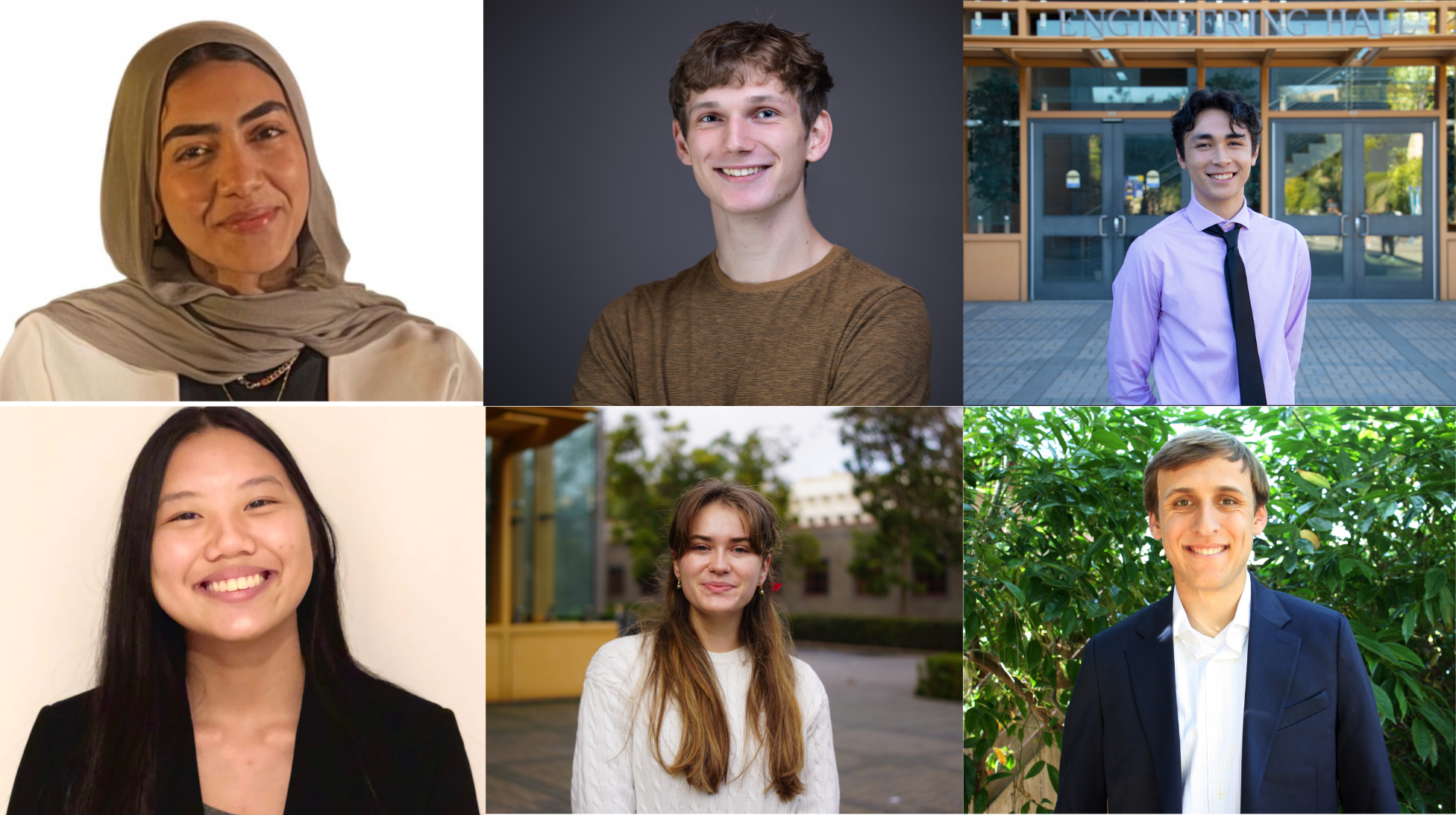
June 2, 2026 (updated)- Six UC Irvine Samueli School students have received a National Science Foundation (NSF) Graduate Research Fellowship Program (GRFP) award this year.
The NSF GRFP recognizes graduate students who are continuing research-based master’s and doctoral degrees in STEM fields, and who have shown potential to make impactful contributions to the field. Each fellowship provides three years of financial support over the five-year fellowship period.
Malak Gamal El-Din is a computer engineering graduate student. Her research involves developing efficient and trustworthy artificial intelligence (AI) systems that are able to run on resource-constrained edge devices. She specifically works with neurosymbolic and hardware-aware machine learning methods that will make AI models more interpretable while also preserving their strong performance. She also designs models that can be deployed on embedded platforms and accelerators, and applied in areas where reliable AI systems are extremely important.
El-Din is advised by Salma Elmalaki, associate professor of teaching in the electrical engineering and computer science department, and works as a researcher for her lab, Pervasive Autonomy.
“I am excited to pursue the NSF Graduate Research Fellowship because it gives me the freedom to explore research at the intersection of efficient AI, hardware systems and trustworthy machine learning,” El-Din said. “As AI becomes increasingly integrated into real-world devices, it is important that these models are not only accurate, but also efficient, interpretable and reliable enough to be deployed beyond large computing environments. This fellowship will support my goal of developing AI systems that can make advanced machine learning more accessible and practical in resource-limited settings.”
Elias Heanue is an electrical engineering major with a concentration in bioelectronics and biotechnologies, as well as flexible and implantable devices. He is advised by Dion Khodagholy, associate professor of electrical engineering and computer science, and serves as a researcher for Khodagholy’s lab, Translational Neuroelectronics. He is also advised by Hyung Joon Shim, who serves as a postdoctoral researcher in the lab.
Heanue’s research focuses on improving neural interfaces that the lab produces and then developing materials and methods that will integrate heterogeneous electronic components with flexible organic polymers in order to allow for more computational power and complex systems.
“There is a critical need for heterogeneous electronic systems that combine the biocompatibility and mechanical compliance of organic materials with the computational and communication performance of inorganic microelectronics to enable chronic, closed-loop neurostimulation in freely moving subjects.”
Scott Duy Kiehn is a materials science and engineering graduate student. He conducts research under the guidance of Kai He, associate professor of materials science and engineering. His lab, Lab for Energy, Nano and Sustainability (LENS), develops energy and quantum materials alongside the microscopy processes used to characterize the materials.
With He, Kiehn has the autonomy to work ambitiously on his own terms, something he believes is necessary for the research he is pursuing.
“Our instruments collectively reveal far more about materials than any researcher can extract from them alone,” Kiehn said. “Closing that gap requires building data-driven integrative infrastructure across multiple characterization techniques – the kind of foundational work a fellowship is uniquely suited to support.”
Lanie Le is a chemical and biomolecular engineering graduate student who works with Stacy Copp, associate professor of materials science and engineering, and Herdeline Ardoña, assistant professor in chemical and biomolecular engineering. Le is a graduate student researcher in Copp’s lab, and currently she is investigating silver-DNA nanocluster probes for biomedical imaging.
“Silver-DNA nanoclusters are promising contrast agents for deep tissue imaging and noninvasive diagnostics due to their near-infrared light emission,” Le said. “As a safer, nontoxic alternative to traditional imaging techniques, they offer a versatile, high-throughput platform for studying diseases like cancer. By improving the in vivo delivery of these nanoclusters, we can fully harness their diagnostic potential and leverage the exciting opportunities enabled by their programmable nature.”
Le believes that this fellowship will help bridge her interdisciplinary background in biomaterials and biophysics-focused cancer research with her interest in nanotechnology. Eventually, she hopes to pursue a career as a professor and serve as a role model for other female scientists in the Vietnamese-American community.
Madeleine Marston is a chemical engineering major who is currently an undergraduate researcher for Herdeline Ardoña’s research lab. Under the guidance of graduate student Kathryn Lee, Marston works on developing visual light initiators and photoconductive biomolecular nanomaterials with assembly state-dependent photohydrogelation pathways and electronic processes.
“My research is important because it explores novel biomaterials that furthers the field of tissue engineering,” Marston said. “I am pursuing a fellowship to continue researching polymeric biomaterials in graduate school.”
Cameron Schmitt is a civil and environmental engineering major currently researching wildfire models, which analyze and forecast how a wildfire might spread as time goes on. Specifically, he focuses on validating these fire models using satellite observations in order to improve how they might perform in extreme wind and complex terrain.
He is being mentored by James Randerson, Chancellor’s Professor of earth system science , as well as Tirtha Banerjee, associate professor of civil and environmental engineering.
“Wildfire forecasts are used nationally to predict fire risks to civilians and infrastructure in real-time, but there is limited systematic understanding of how these models perform across a wide range of landscapes and weather conditions,” Schmitt said. “My work seeks to evaluate model performance and biases in the extreme conditions they are expected to operate in.”
– Grace Hefner
