
Students Showcase Innovation at 2026 Beall Butterworth Competition
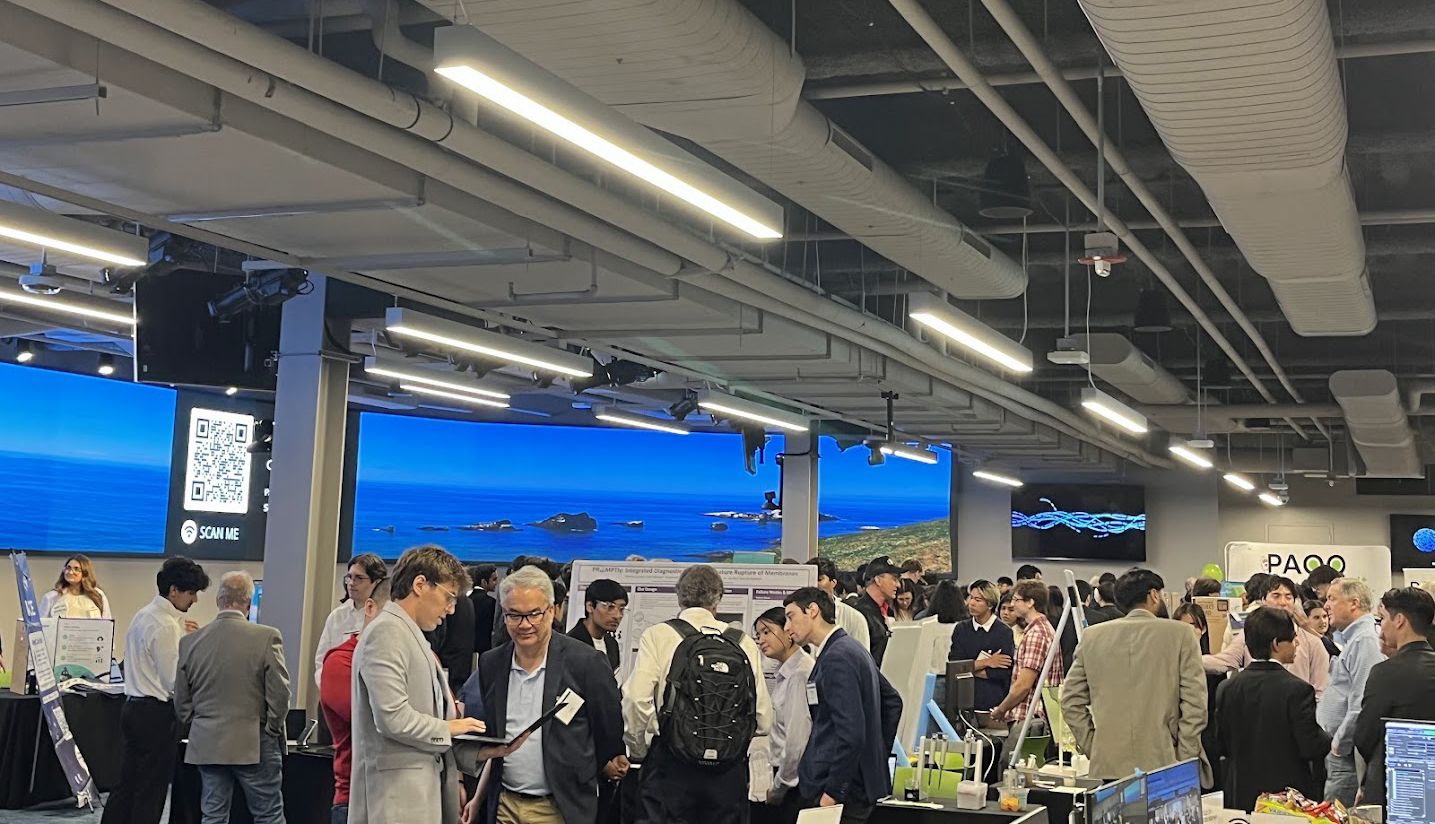
June 1, 2026 - Innovation and entrepreneurship were on display at the 2026 Beall Butterworth Competition, a six-month contest that culminated in an on-campus Demo Day and awards ceremony on May 15. While the competition is open to all UC Irvine students, teams must be composed of at least one student from the Donald Bren School of Information and Computer Sciences (ICS) in the Butterworth Product Development category and one engineering student in the Beall Student Design category. With esteemed industry leaders serving as judges, students presented their projects at The Cove, a 31,000 square foot collaborative work and event space located at University Research Park.
The top teams for each category received $10,000 for first place, $6,500 for second place, and $3,500 for third place.
Butterworth Product Development Competition
BillBack won first place for their AI-powered medical billing audit platform which helps self-insured employers identify billing errors in their medical claims and recover detected overcharges. Because self-insured employers pay employee healthcare claims directly out of pocket, they bear the full financial risk of every claim processed. To manage this complexity, most self-insured employers outsource claims administration to Third-Party Administrators (TPAs), organizations responsible for processing, auditing, and managing healthcare claims on their behalf. However, even TPAs struggle to catch billing errors because claims auditing today remains highly manual, requiring analysts to review CPT codes, fee schedules, duplicate billing, and clinical documentation claim by claim, making comprehensive auditing nearly impossible at scale. As a result, billions of dollars in overcharges go undetected, with employers absorbing these costs every year. To solve this, BillBack leverages AI and machine learning capabilities to automatically detect billing errors in medical claims, predict which flagged errors are most likely to result in a successful recovery, and generate fully drafted, ERISA-compliant dispute letters ready to file with the provider. This reduces the entire audit and dispute workflow from nearly an hour to under 60 seconds. The primary target market is small to mid-size Third-Party Administrators serving self-insured employer clients.
Team: Anup Kumar, Anusha Reddy Amula, Benjamin Ogboye, Karan Jain, Richa Rao, Shri Prasanna
Auréa placed second with a B2B SaaS platform that turns generative AI video from a slot machine into a production tool for filmmakers. Today’s tools force creators to re-roll an entire shot to change a single detail, lose continuity from one shot to the next, and produce footage that doesn’t survive a professional color pipeline. Auréa solves all three: a layered editing engine lets users lock the parts of a shot they like and regenerate only what they don’t, a persistent World Memory carries locations, characters, and props consistently across an entire sequence and an in-loop log conversion. The initial target is AI filmmakers and traditional filmmakers who are willing to try these AI models.
Team: Farrin Marouf Sofian, Kushagra Pandey
Socratic OC took third place with an all-in-one academic support app built around not just the tutor/educator but also the student. Instead of students/tutors having to switch between Canvas, calendars, email, and messaging apps, Socratic OC brings the most important academic tools into one place.
Team: Bruhati Aarushi Kuchi, Daniyal Rauf, Jamal Alardah, Rutu Aarabhi Kuchi, Tanvi Badadare
Beall Student Design Competition
Neovi Medical won first place for NeoFusion, a fully mechanical neonatal syringe pump designed to deliver life-saving fluids and medications with neonatal-grade precision in environments where traditional electric pumps fail. Every year, millions of newborns in low-resource settings lack access to reliable infusion therapy due to high equipment costs, unstable electricity, and fragile medical infrastructure, contributing to preventable neonatal deaths worldwide. NeoFusion addresses this critical gap through a spring-powered, pendulum-regulated mechanical system capable of delivering accurate infusions without electricity, batteries, or complex electronics. By combining precision, durability, affordability, and ease of use into a single device, NeoFusion empowers healthcare providers in low-resource clinical settings anywhere in the world to safely treat vulnerable newborns.
Team: Aditi Ranabhor, Christopher Tan, Keerthana Anand, Kevin Gurney, Sarah Liu
Natavue took second place for an approach that helps improve maternal and neonatal outcomes by reducing infection rates during delivery. More than 4 million births occur in the United States annually, with most laboring mothers undergoing multiple manual cervical exams that have high variability rates and carry infection risk. The team has devised a method for obtaining essential labor metrics via an ultrasound-compatible urinary catheter that provides continuous, objective measurements of cervical dilation and fetal vitals while integrating seamlessly into existing care. The results of modeling demonstrate both clinical feasibility and engineering performance, with the potential to reduce infections, improve measurement accuracy, and enable earlier interventions during high-risk deliveries.
Team: An Tran, Anthony Istaphanous, Dathan Nguyen, Isaac Torosian, Joshua Varela, Lucas Jones
Atmadyne placed third for building plug-and-play robotic actuators and integrated motion systems for the next generation of embodied AI and advanced robotics. Today, developing capable robots is still difficult, expensive, and fragmented, requiring teams to spend significant time integrating hardware, configuring software, and troubleshooting unreliable systems. Existing solutions are either easy to use but too limited for dynamic robotics, or powerful but prohibitively expensive and difficult to integrate. Atmadyne aims to bridge this gap by creating affordable, high-performance smart actuators and reference robotics platforms designed to work together out of the box. Their systems combine BLDC-class performance, modular hardware, integrated electronics, and developer-friendly software to dramatically reduce the complexity of building advanced robots for researchers, developers, educators, and emerging robotics companies.
Team: Churui Deng, Hriday Ram, Jonathan Lin
2026 International Collaboration Prize
The International Collaboration Prize allows UC Irvine students to partner with students from Brazil’s Pontifical Catholic University of Rio Grande do Sul (PUCRS).
UNI won first place for an AI agent friend system that helps users turn ideas into clear plans and real action. It combines three roles in one product: a productivity tool, emotional support, and an AI agent. In simple terms, UNI does not just help users record tasks. It helps users clarify what they want to do, break it down, schedule it, and keep moving through execution through agent capabilities.
UC Irvine Team: Jeremy Li, Runcheng Gao, Shixin Huang, Ziran Ge
Pontifical Catholic University of Rio Grande do Sul (PUCRS) Team: Rafael Barbosa Asmuz
– Tonya Becerra
