
Tissue-like Implant to Bring Electricity to Devices Inside the Body
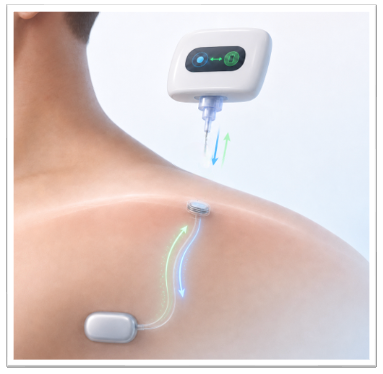
July 8, 2026 - Imagine someone charging their pacemaker not with the usual surgery but with just a brief prick of a thin needle. That could soon be possible with a groundbreaking sponge-like material called an Implantable Bioelectronic Outlet (IBO) created by UC Irvine researchers.
The IBO is designed to live inside the body and aims to enable devices that are implanted in the body, like pacemakers, to be recharged without surgery. It also can deliver electric stimulation to and transmit digital data from the body. A team led by Dion Khodagholy, UCI associate professor of electrical engineering and computer science, created the IBO. The research tests on small and large animals has just been published in Science Advances.
“The IBO is able to very effectively deliver stimulation similar to as if you directly connected wires,” said Khodagholy. “This is very exciting because not only can it can be used for diagnostic purposes, but perhaps it can also facilitate therapeutics where specific doses of stimulation are needed per day.”
Khodagholy aims to use the IBO to deliver electric therapies to patients for neuropsychiatric, cardiac, arthritic and inflammatory disorders as well as for cancer therapy.
A New Approach to Transmit Electricity to the Body
Current implantable medical devices such as deep brain stimulators and pacemakers cannot connect to the outside world so their batteries need to be replaced about every 10 years through surgery. Some implants rely on electromagnetic radio waves, ultrasound or near-infrared signals to transmit energy through tissue. But these methods make the implant bulky and require the delivery of large amounts of energy, making them unsuitable for children and the elderly. Other wired connections that pierce the skin also carry risks of infection, scarring and other complications.
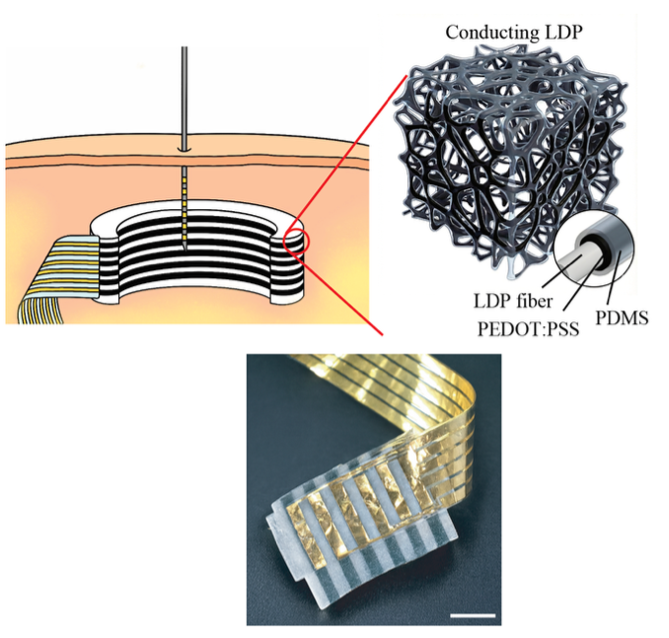
Khodagholy’s team overcame these challenges through a different approach: their IBO is modeled after biological tissue so it can exist inside the body. The IBO looks like a soft, thin sponge and has electronic properties that enable it to exchange information or deliver power between the body and the outside world.
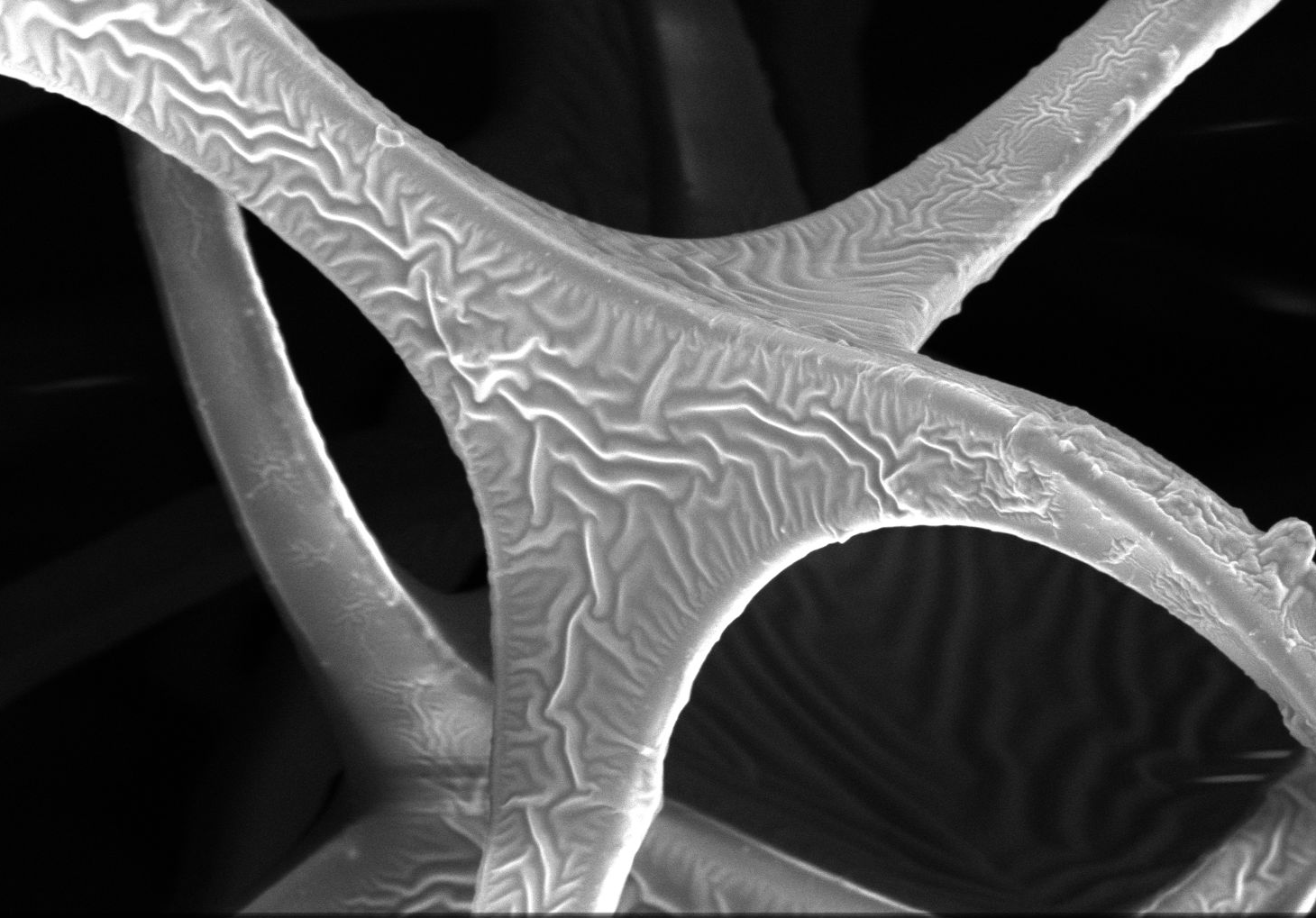
The team made the scaffold of the IBO from melamine, which resists water absorption, to prevent leaks that could damage electronics or surrounding tissue. Then they coated the tiny pore walls with a layer roughly 100 to 200 nanometers thick of the conducting polymer PEDOT:PSS. This gave the sponge-like material the ability to conduct electricity. To insulate those conducting layers, the entire structure was then dipped in a solution of PDMS (polydimethylsiloxane), a soft, flexible silicone-like material which formed a protective jacket around the foam fibers. The result is a fully insulated, soft and lightweight connector that can sit safely inside the body.
Successful Tests
This bioelectronic connector has integrated well inside the bodies of rodents. Khodagholy implanted the IBO subcutaneously under the skin for more than a year and was able to extract it with minimal scarring and no damage to surrounding tissues. “The tissue around it was so healthy. You could see little blood vessels. We were very surprised,” said Khodagholy since there is usually visible scar tissue around an implant. He explained the reasons for minimal scarring. “First, it is low density, really mechanically mimicking the surrounding tissue,” he said. “Second, the materials are highly biocompatible.”
The materials were tested after a year in the rodents and were found to have very similar properties to the original implant. They were able to maintain their electrical properties well. The conducting LDP impedance was consistently under 100 ohms making it suitable for directly interfacing with electrophysiological sensors, and it was able to transmit digital data at close to 16 megabits per second.
The connector was used to bring electricity inside the rodent, a function that could similarly be used to charge a pacemaker and deep brain stimulators in patients. It was also able to transmit digital data from inside the rodent to the outside world. The lab recorded the non-rapid eye movement sleep from a rodent who had just finished a behavioral task to see how coupling of different oscillations could be linked to learning and memory consolidation.
The lab also worked with ophthalmologist Kim Gokoffski of the UCI Gavin Herbert Eye Institute to test the connector on pigs. The IBO was placed beneath the skin behind the ear to connect to a separate conformable electrode that was wrapped around the optic nerve. The IBO served as an access point whereby a very tiny needle pierced the skin through the IBO to provide stimulation to the nerve.
Another important feature of the IBO is that it is crack-resistant, which means it can be punctured with a needle over and over again without cracking or tearing. This would make it a durable material to deliver electronic connectivity. Its unique mechanical resilience also allowed stable, repeatable connections without damaging surrounding tissues.
The Future of IBO
Khodagholy said that the classic materials used in the IBO are already approved by the FDA for long-term implants in the body. “We already know these devices are very, very safe,” said Khodagholy. “Because the IBO is so small and we already have many subcutaneous implants as a device available, we think that the time it will take to become a real product will be relatively short.”
He is currently working with the Advanced Research Projects Agency for Health (ARPA-H) to use the IBO for an eye transplant and is pursuing an Investigational Device Exemption, which allows the device to be used in humans, from the FDA.
The UCI research team for this groundbreaking IBO includes Hyung Joon Shim, Liang Ma, Jose Ferrero Lopez, Duncan Wisniewski, Kimberly Gokoffski, Jennifer Gelinas and Dion Khodagholy from the departments of electrical engineering and computer science, anatomy and neurobiology, pediatrics, biomedical engineering and the Gavin Herbert Eye Institute.
- Natalie Tso
