
The Secret to Affordable Biomanufacturing: UC Irvine Researchers Find Nature’s Recipe
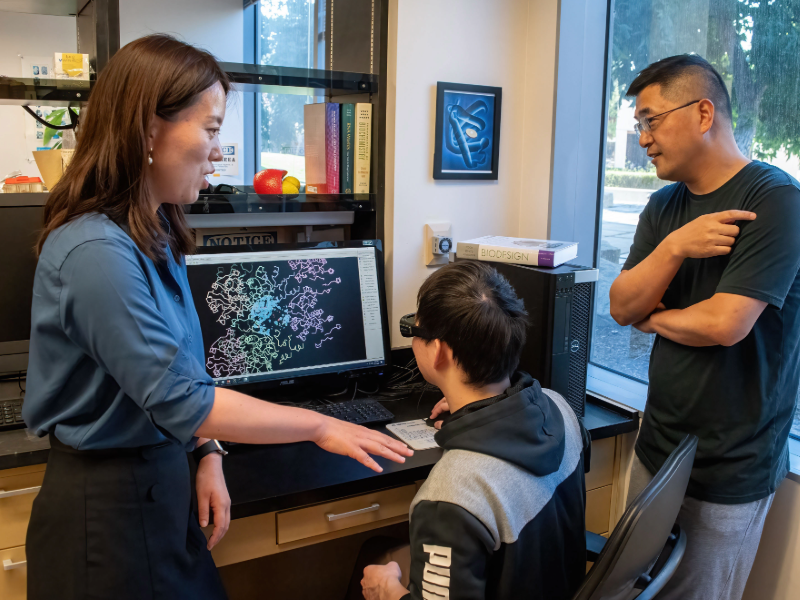
Biomanufacturing helps us create everything from biodegradable plastics to life-saving vaccines, and enzymes are the catalyst for that process.
“Think of enzymes as tiny biological machines inside every living cell,” says Han Li, PhD, an associate professor of chemical and biomolecular engineering in the UC Irvine Samueli School of Engineering. “Like any machine, they need fuel to run.”
Most enzymes depend on a specific, expensive “fuel” molecule called nicotinamide adenine dinucleotide (NAD+) — a form of vitamin B3 that the cell must carefully produce and manage. “Using these molecules at industrial scale is costly and creates unwanted side effects in the production process,” explains Li. “Finding cheaper, cleaner alternatives has been a major unsolved challenge for decades.”
Partnering with Feng Qiao, PhD, a professor of biological chemistry in the UC Irvine School of Medicine, Li led a team of UC Irvine researchers in finally identifying an alternative.
“We discovered a natural ‘secret code’ — a short, recurring pattern hidden inside a family of proteins called aldehyde dehydrogenases, or ALDHs — that allows these tiny machines to run just as well, or even better, on a much cheaper fuel,” says Qiao.
That cheaper fuel is called nicotinamide mononucleotide (NMN+), also a form of vitamin B3.
“Crucially, this secret code is not something we invented. We found it already embedded in nature, in proteins from cows and bacteria,” says Li. “We found nature’s own recipe for running biological machines on a cheap, widely available fuel, and we can now transfer that recipe to other machines.”
Finding Nature’s Secret Recipe
Using X-ray crystallography — a technique in which proteins are grown as tiny crystals and bombarded with powerful X-rays at a national synchrotron facility (NSLS II) — the team produced atomic-resolution snapshots of a protein’s three-dimensional shapes.
“By capturing the protein’s structure at atomic detail, as fine as 1.4 ångströms, roughly one 10-billionth of a meter,” says Qiao, “we could see, for the first time, exactly how this secret code physically rearranges the protein’s internal architecture to grip and position the cheaper fuel molecule.”
The team outlines their findings in a paper, “A Sequence Motif Enables Widespread Use of Noncanonical Redox Cofactors in Natural Enzymes,” published on Sept. 9, 2026, in Nature Chemical Biology.
The machines equipped with this code — a handful of amino acid building blocks — ran on the cheaper fuel at speeds matching or exceeding those using the expensive fuel.
“They outperformed any previously engineered alternative by up to 100,000-fold,” says Qiao.
The team also showed that they could copy this short code into other, unrelated protein machines and instantly give them the same ability, boosting their efficiency on the cheaper fuel by up to 60-fold.
“This turns a single finding into a broadly useful engineering tool,” says Li. “With this discovery, industrial processes can potentially use NMN+ in place of these expensive molecules, dramatically reducing costs for producing medicines, chemicals and other bio-based products.”
From Molecules to Medicine
The team’s discovery might do more than affect industrial processes; it could also help us better understand eye disease.
The same family of proteins that the team studied in the lab also plays a critical protective role in human eyes. ALDH proteins in the cornea act as protective shields, neutralizing damage from sunlight and ultraviolet radiation.
“As we age or develop eye disease, the eye’s ability to produce its normal fuel (NAD+) breaks down,” says Li. “Our research suggests that the eye’s dominant protective enzyme may be naturally equipped, thanks to this ‘secret code,’ to switch over to using NMN+ as a backup, which poses the question of whether NMN+ keeps protection going even when the normal fuel supply runs low. This question remains unanswered in this study.”
This opens a window into better understanding age-related eye disease, corneal damage and conditions driven by oxidative stress in the eye.
“We plan to measure, in real eye tissue under oxidative stress, whether NMN+ actually accumulates to levels high enough for this fuel-switching to matter, and whether the ALDH enzymes are indeed using it as a backup fuel under those conditions,” says Li. “This is a critical step from laboratory discovery to biological reality.”
The team also plans to continue exploring how widely the new “secret code” can be transplanted across different enzyme families, further expanding this new engineering toolkit.
This work was supported through funding from the Advanced Research Projects Agency–Energy EcoSynBio program, the National Science Foundation, the National Institutes of Health, the U.S. Department of Energy and a Sloan Research Fellowship.
— Shani Murray
