
CBE 298 Seminar: Teaching Transport Phenomena Through Observation - From Einstein’s Tea Leaves to Dissolving Skittles
Abstract: The teaching of Transport Phenomena often relies heavily on mathematical abstraction, yet the physical intuition required to master the subject is most effectively developed through observation. As Richard Feynman famously noted in the wake of the Challenger inquiry, ”Nature cannot be fooled,” a reminder that physical reality, not formalism alone, must anchor our understanding. To build this intuition in the classroom, we can look to an unexpected source for inspiration: Albert Einstein.
While revered for identifying the equivalence of mass and energy, Einstein’s most frequently cited works from his annus mirabilis actually lie in the realm of fluid mechanics. From his Ph.D. thesis on suspension viscosity to his proof of atoms via Brownian motion, he consistently used fluid behavior to decode physical laws. In 1926, he applied this same observational rigor to a tea cup, using the secondary flows of the stirred fluid to explain the geological formation of river meanders. He described this simply as ”a little experiment which anybody can easily repeat.”
Following this philosophy, this seminar explores the use of simple, low-cost tabletop demonstrations to illustrate complex transport concepts that recur across momentum, heat and mass transfer. Among other examples, we will examine the spin-up of a beaker to visualize the boundary driven secondary flows described by Einstein, and analyze the dissolution of Skittles candies to visualize mass transfer boundary layers and Rayleigh-Taylor instabilities. Finally, we look at the value of "flipping the script" by having students design their own demonstrations. This reinforces the idea that while math describes physics, observation is what motivates it.
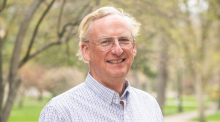
Bio: David T. Leighton, Jr. is a professor of chemical & biomolecular engineering at the University of Notre Dame. His research focuses on transport phenomena, with particular emphasis on the rheology and dynamics of suspensions. He received his bachelor's degree from Princeton University and his doctorate from Stanford University under the direction of Andreas Acrivos, followed by a NATO Postdoctoral Fellowship at the University of Cambridge with George Batchelor.
In parallel with his research career, Leighton has spent over four decades teaching undergraduate and graduate transport phenomena. He has developed and refined a large collection of classroom demonstrations aimed at helping students connect mathematical models with physical intuition. This work is collected in A Teacher’s Guide to Classroom Demonstrations in Transport Phenomena (2025), which presents 36 hands-on demonstrations drawn from this long classroom experience. He has also made available A Compendium of Problems in Transport Phenomena, a curated collection of problems used in his undergraduate courses over many years.
Professor Leighton has received multiple teaching awards, including the B.P.-Amoco Teacher of the Year Award. He is also active in STEM outreach and has served for over 20 years as director of judging for the Northern Indiana Regional Science & Engineering Fair.
Share

Related Content
| Attachment | Size |
|---|---|
| 772.82 KB |
Upcoming Events
-
CBE 298 Seminar: Coffee as a Platform for Experiential Chemical Engineering Education: From Qualitative Design to Quantitative Analysis
-
EECS Seminar: Printed Electronic Skin for Robots and Interactive Systems
-
MSE 298 Seminar: Illuminating Microstructure-Dependent Binding and Delivery of Nucleic Acids via Gradient Copolymerization and Field Flow Fractionation
-
MSE 298 Seminar: Illuminating Microstructure-Dependent Binding and Delivery of Nucleic Acids via Gradient Copolymerization and Field Flow Fractionation