
CEE Seminar: A Bellwether for Change - Groundwater and Sea Level Rise in Southeast Florida
Department of Earth and Environment
Institute of the Environment
Florida International University
Miami, Florida
2026 Birdsall-Dreiss-LaMoreaux Distinguished Lectureship
Abstract: Interactions between post-glacial sea level and groundwater likely sculpted the current landscape of Southeast Florida. Following a stabilization of sea level 7,000 years ago, which has been credited with an explosion of complex human societies, sea levels are on the rise again in Southeast Florida, and groundwater is rising along with it. As in many low-lying coastal areas, this means there is less room for stormwater storage in the subsurface. A groundwater-centric view of flooding may be appropriate in many of these environments, and a preliminary assessment of this approach is presented.
Dense urban development near the shore severely limits permeable areas for stormwater infiltration and exposes infrastructure to corrosive saltwater. Disposal of fresh stormwater into saltwater lenses and wedges via injection wells is a widely applied strategy that has not been adequately studied before; exploratory simulations are being conducted. While the corrosive effects on metallic pipes and above-ground reinforced concrete are well known, the impacts of saltwater interfaces and tidal fluctuations in the subsurface on foundations passing through zones of varying salinity have not been broadly investigated.
The 2021 collapse of the Surfside tower and the observed sinking of numerous high-rise buildings in Southeast Florida demand a fuller understanding of subsurface conditions and processes. A near-shore coastal subsurface monitoring system is being implemented.
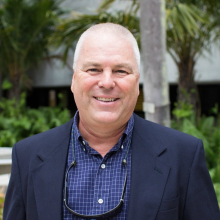
Bio: Michael Sukop is professor of hydrogeology in the Department of Earth and Environment and the Institute of Environment at Florida International University in Miami, where he has taught and conducted research since 2003. He is a fellow of the Geological Society of America, a licensed professional geologist and a certified hydrogeologist in California.
He principally works on groundwater issues in Southeast Florida, including saltwater intrusion, septic systems, injection wells and groundwater inundation. He has expertise in groundwater and solute transport modeling especially as they apply to seawater intrusion and the physics of the Biscayne Aquifer. He co-authored Version 4 of the popular SEAWAT model for seawater intrusion. He is author and co-author of two books on Lattice Boltzmann computational fluid dynamics modeling.
Share

Upcoming Events
-
CBE 298 Seminar: Coffee as a Platform for Experiential Chemical Engineering Education: From Qualitative Design to Quantitative Analysis
-
EECS Seminar: Printed Electronic Skin for Robots and Interactive Systems
-
MSE 298 Seminar: Illuminating Microstructure-Dependent Binding and Delivery of Nucleic Acids via Gradient Copolymerization and Field Flow Fractionation
-
MSE 298 Seminar: Illuminating Microstructure-Dependent Binding and Delivery of Nucleic Acids via Gradient Copolymerization and Field Flow Fractionation