
UCI Students Transcend Musical Boundaries with Inventions
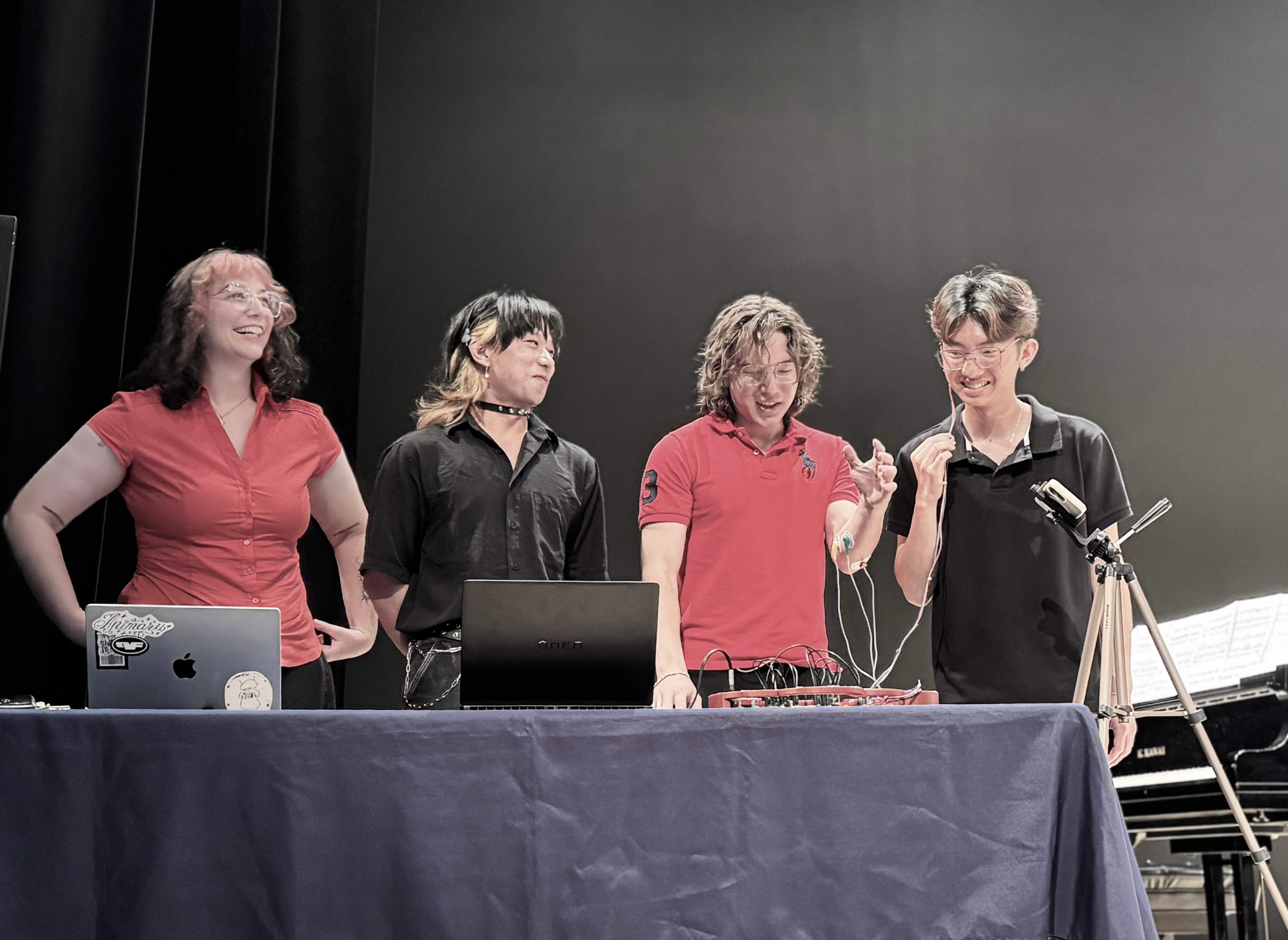
May 21, 2026 - UC Irvine students challenged the limits of music through their inventions showcased at the third annual Engineering-Symphonic Orchestra New Instrument Competition (E-SONIC) on Monday. Jars filled with water, XYZ coordinates, dancing gloves and heartbeat-led-percussion were just some of the creative ways students expanded the boundaries of sound with their musical instruments.
The annual event is hosted by the UCI Samueli School of Engineering. Most participants were engineering students, but the creators also included students across campus who major in physics, computer science, music and social ecology. “It’s a super collaborative project where we get to combine art and engineering,” said mechanical engineering senior Vanessa Shimizu.
The Bubble Box team introduced water and fluid dynamics into the world of music. They use jars filled with water and a “bubble ring,” a rotating donut-shaped fluid, that actuates sensors at the bottom of the cylinders to trigger musical notes.
Electrical engineering senior Lucas Kang of the Chordinates team said they wanted to expand the dimensions of music by going 3D. “We wanted to show that even integrals of space can produce music,” Kang said. Their system maps XYZ position data to pitch, spatialization and other parameters to make sound as the players walk around with their devices to create 3D motion.
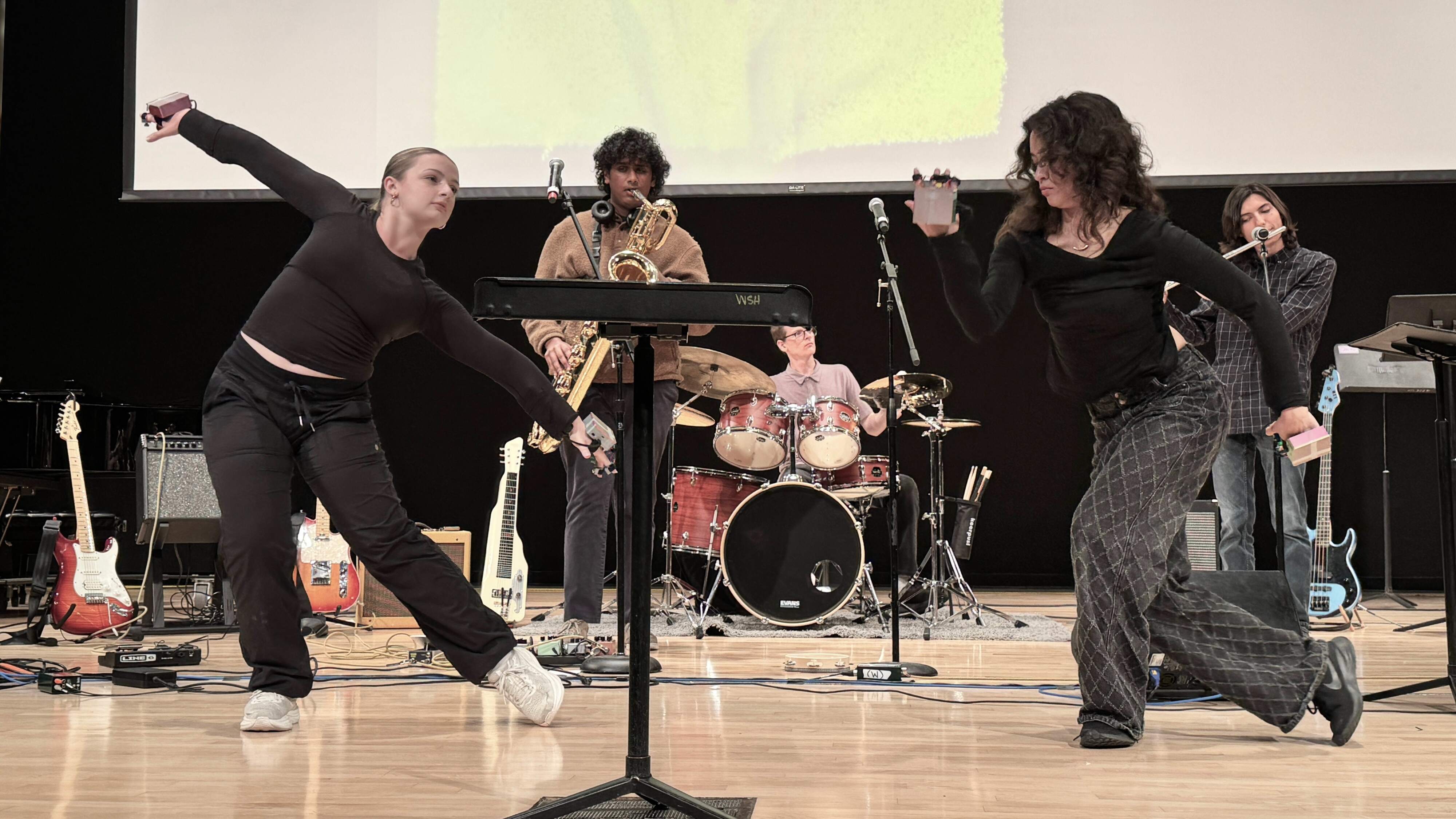
Musical gloves and performance were the themes for the Jazz Hands and Pas de Deux teams. With Jazz Hands, the player slips on the gloves and draws two boxes in the air. Then the user plays notes inside those boxes by tapping specific regions and instruments. The team said they wanted to show that you can “make sounds from thin air.”
Pas de Deux, “a step for two” in French, challenges the solitary nature of a musical instrument as it requires two people to play. Two persons wear gloves and move their hands in relation to each other to produce sounds. It was the most visually artistic of the performances as two dancers dressed in black moved their hands and bodies to create never-before-heard music.
The winner of the competition was StringTone, which uses the power of magnets to perform music. The students created a sound design instrument that uses Hall effect sensors, which measure the magnitude of a magnetic field, and turn them into 512 electrical signals. Those signals become waveform, repeating patterns that produce notes. Why magnets? “Because they’re cool,” said applied physics senior Alex Ikeda, who also was on the winning team for last year’s contest for their instrument Sali-Nity which turned salt into sound.
Ikeda said their main aim was to get the sounds they wanted in a quicker manner than usual synthesizers. “We have magnets which can be moved around at will to control the sound of the instrument,” Ikeda said. Users can even use magnets to draw a smile or whatever shape they desire to create the wave table which creates the sound.
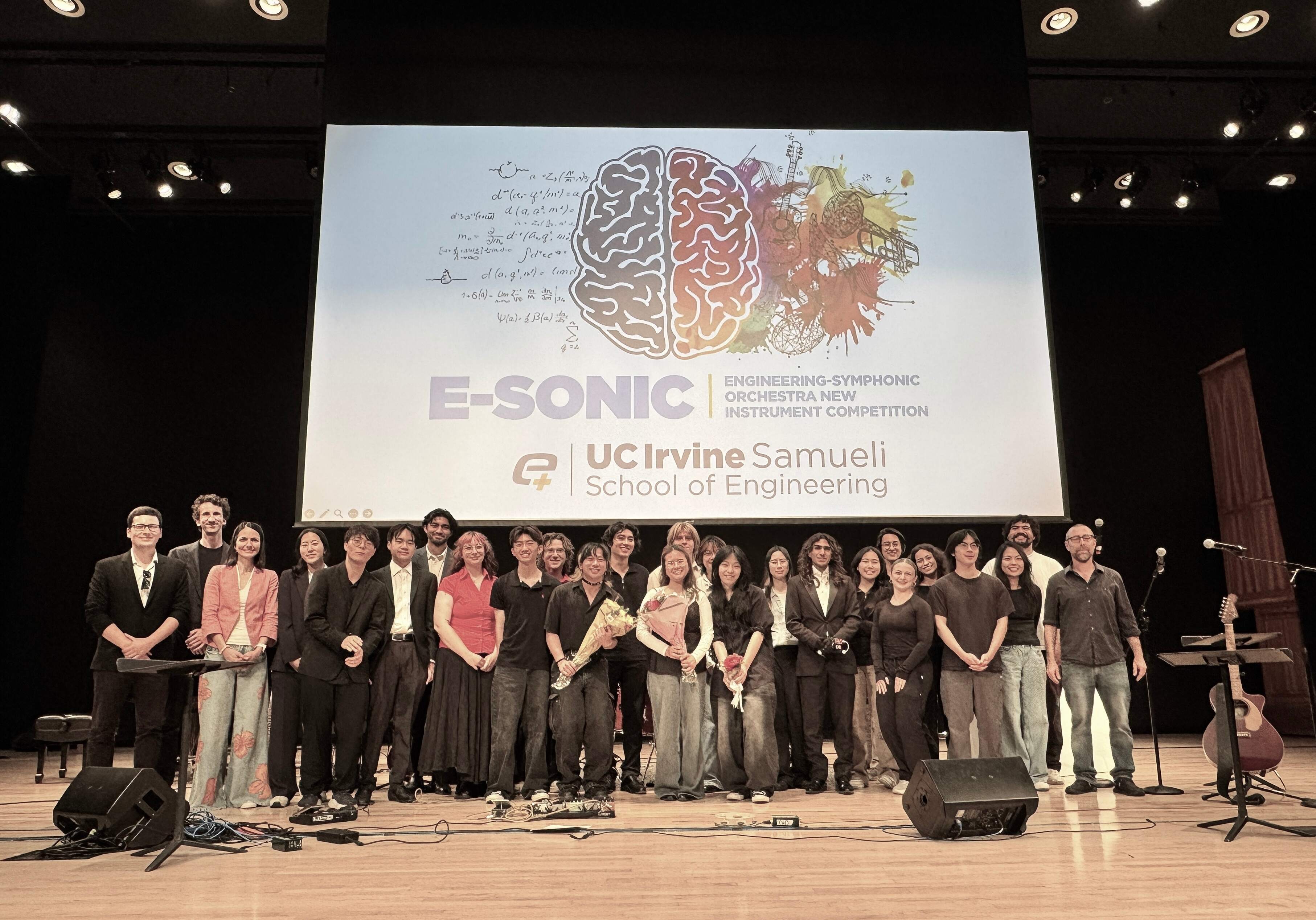
HeartThrob won the People’s Choice Award as it was a clear favorite. Emilio Aris Lim, computer science and engineering senior, said he was inspired by his work at UCI assistant professor of biomedical engineering Pim Oomen’s Beat Lab which studies the cardiovascular system. Lim recruited his friends to make an instrument that uses sensors to convert the body’s natural rhythms into what the team described as “a drum machine reminiscent of those back in the 70s and 80s.”
They used an ECG to measure heartbeat, a PPG to measure blood flow and an PPG to measure muscle activity. Those unique rhythms create percussion sounds tailored to the person’s body. Engineering senior Kai Cheung quipped, “Heart throb turns you into the instrument as long as your heart’s in the right place.”
Faculty mentors for E-SONIC doubled as the cool band that opened the competition and rocked to songs like Taylor Swift’s “Shake It Off” and Green Day’s “Good Riddance” throughout the evening. Engineering faculty Pim Oomen, Maxim Shcherbakov, Bihter Padak and Ali Mohraz advised students and performed along with former Samueli School of Engineering Dean Magnus Egerstedt who made a guest appearance.
“E-SONIC is a unique opportunity for our students to show their artistic and creative sides while applying their engineering skills,” said assistant professor of mechanical and aerospace engineering Bihter Padak. In its third year, E-SONIC has been an excellent way to allow students to show off their musical engineering ingenuity while earning academic credit.
- Natalie Tso
