
Biomedical Engineers Send Cartilage Tissue Experiment to Space
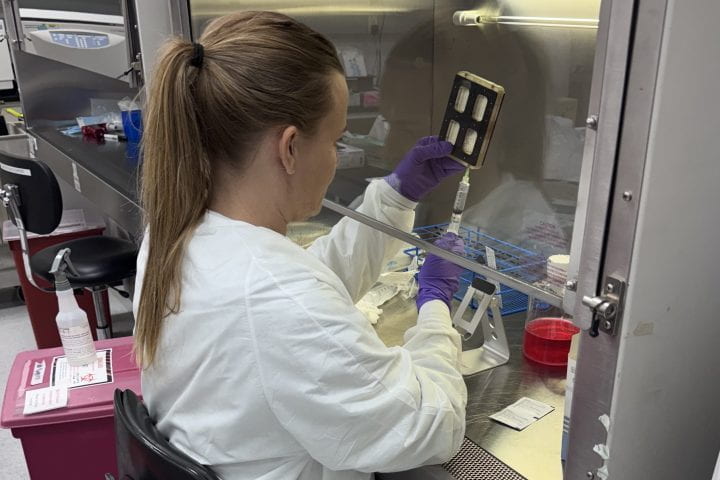
June 29, 2026 - Researchers in UC Irvine’s Department of Biomedical Engineering are relying on the microgravity environment of the International Space Station to help build new cartilage tissue.
For a project funded by the National Science Foundation, the UC Irvine researchers began by preparing cartilage-producing cells for the trip to space. In mid May, an experiment was launched to the ISS on a rocket from Cape Canaveral Space Station in Florida; onboard was flight-certified hardware developed by BioServe Space Technologies at the University of Colorado Boulder with samples taken for study from the first hours of differentiation to nearly 30 days of neocartilage culture. The samples are preserved using Parse Biosciences’ Evercode Cell Fixation with the intention of being returned to Earth for single cell RNA sequencing.
For years, scientists in the DELTAi laboratory, under the guidance of Kyriacos Athanasiou, Distinguished Professor of biomedical engineering, have been working to develop remedies to cartilage injuries which cause pain and disability to people around the world. According to Athanasiou, the need for implants that can repair or regenerate damaged tissue without harming the donor site has gone unmet for decades.
Gravity can work against the formation of cartilage tissue in a lab, but the near weightlessness of space can help get around that problem. A growing line of research suggests that tissues engineered in orbit can come closer to the real thing than tissues engineered on the ground.
“The ability to study rejuvenation of our cells in microgravity at the single cell level requires us to be able to effectively preserve the cells with a long storage timeframe,” said project leader Rachel Nordberg, UC Irvine associate specialist in biomedical engineering.
Co-principal investigator Wendy Brown, UC Irvine associate specialist in biomedical engineering, added, “Parse offers the perfect solution to give us the flexibility we need to study minipig cells, collect samples at multiple timepoints, and handle the unpredictability of spaceflight operations.”
Parse Biosciences co-founder and chief technology officer Charlie Roco said, “What the UC Irvine team is doing is remarkable. Engineering cartilage in microgravity could fundamentally change how we think about tissue repair, and the fact that they are running this level of single cell work from samples preserved in orbit is a real testament to the rigor of their science.”
