
Transforming Concrete for a More Sustainable Future
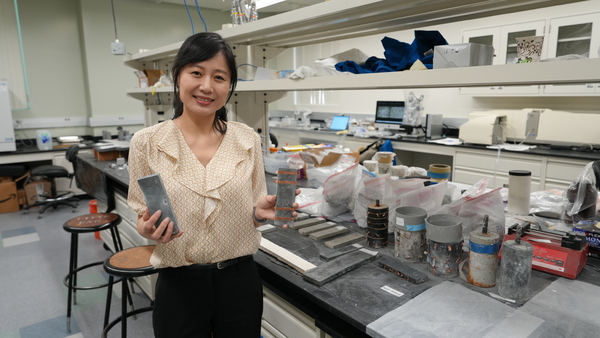
June 14, 2026 – Concrete holds up the modern world. It spans highways, raises skylines and shapes art museums; it shields nuclear reactors, anchors wind turbines, fortifies bunkers and paves airfields. It is the world’s second most-used material after water, but its environmental footprint is enormous. Cement, the binding ingredient in concrete, produces about 8% of global carbon dioxide emissions, while demand for sand is depleting rivers, coastlines and quarries.
For Mo Li, professor and chair of the Department of Civil and Environmental Engineering at UC Irvine, making concrete more sustainable is one of the most important engineering challenges of this century.
Her research lab is developing technologies that make concrete more sustainable across its entire life cycle – from cleaner cement production and more efficient manufacturing to smarter, longer-lasting infrastructure and the recovering of materials for the next generation of construction.
One of Li’s most notable innovations embeds concrete with a microcracking mechanism coupled with self-sensing and self-healing functionalities. Instead of relying on visual inspections or point-based external sensors, the concrete itself – through its engineered electromechanical behavior – acts as a distributed sensor and continuously monitors its own condition. Rather than depending solely on repairs, the material is designed with the chemical capacity and damage tolerance to heal many of its own microscopic cracks over time.
“Enabling structural concrete to behave as a spatial sensor gives us a truly distributed sensing medium,” Li said. “It allows the detection of damage where it occurs within the material and structural components, including cracking, deterioration and corrosion of the embedded steel reinforcement.”
The result is concrete infrastructure that is safer, longer lasting and less carbon intensive throughout its use phase. Earlier detection of damage and autogenous healing reduce maintenance, extend service life, and decrease the materials and construction activities that consume energy and release CO2.
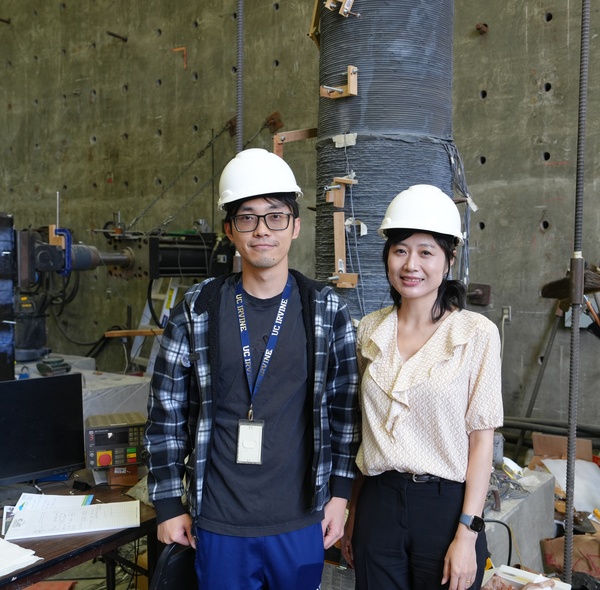
Another major breakthrough focuses on decarbonizing cement production. Li works with UCI professor Iryna Zenyuk, director of the National Fuel Cell Research Center, to develop an electrochemical process for producing Portland cement using clean electricity instead of fossil fuels. This technology significantly reduces carbon dioxide emissions from both limestone calcination and the high-temperature combustion used in conventional cement manufacturing. In collaboration with industry partners, the team is now scaling the electrochemical cement production process beyond the laboratory.
Li’s lab is also rethinking what happens when concrete reaches the end of its service life. Rather than treating demolished concrete as waste, her team is developing new methods to recover high-quality sand, cement precursors and other valuable minerals for use in new concrete, while maintaining, or even improving, the mechanical performance of concrete. Achieving this requires advanced chemical and electrochemical recovery of minerals, in collaboration with Zenyuk’s lab, together with strategic tailoring of cementitious material chemistry, processing, microstructure and interfaces. The long-term vision is a circular manufacturing system that reduces reliance on virgin raw materials, minimizes waste and keeps concrete materials in continuous use, redefining how concrete infrastructure is built, maintained and renewed.
Li’s vision is straightforward: infrastructure that is safer, lasts longer, requires fewer natural resources to build and maintain, produces less carbon and better serves the communities that depend on it.
- Natalie Tso
