
New Summer Academy Immerses High School Students in Marine Science and Engineering
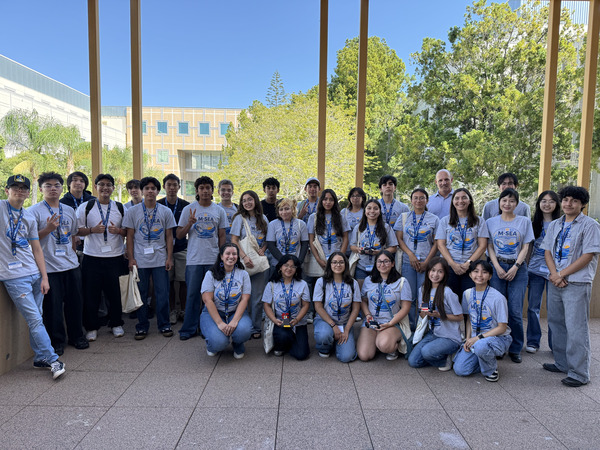
July 31, 2026 - On Monday morning, 25 high school students gathered in a laboratory at UC Irvine, mixing marine concrete engineered to heal its own cracks in sea water. By Tuesday afternoon they were operating a large 3-D printing robot to manufacture offshore components and learning how RaccoonBot, an environmental sensing robot, is designed and brought to life. Later in the week, they were several miles offshore, drawing seawater samples over the rail of a research vessel, testing them for pH, dissolved oxygen and turbidity, and identifying the organisms they had collected.
That week was the inaugural summer academy of M-SEA – the Self-Healing Ocean Infrastructure and Marine Science and Engineering Academy – a research and education program at the UC Irvine Samueli School of Engineering, in collaboration with the Ocean Institute and supported by the Nicholas Endowment. The academy, held August 3–7 at both UCI and the Ocean Institute in Dana Point, is where the year’s work comes together. The rest of the year goes into the science: engineering the biomimetic self-healing materials and robotics, and building the curriculum and laboratory modules the academy runs on.
Designed to introduce high school students to the intersection of engineering and marine science, M-SEA combines hands-on learning, exposure to emerging research and real-world applications, and opportunities to explore pathways to college and careers in STEM. Through experiences both on the UCI campus and at the Ocean Institute, students were encouraged to expand their understanding of these fields while gaining early exposure to the university environment and the educational opportunities available to them.
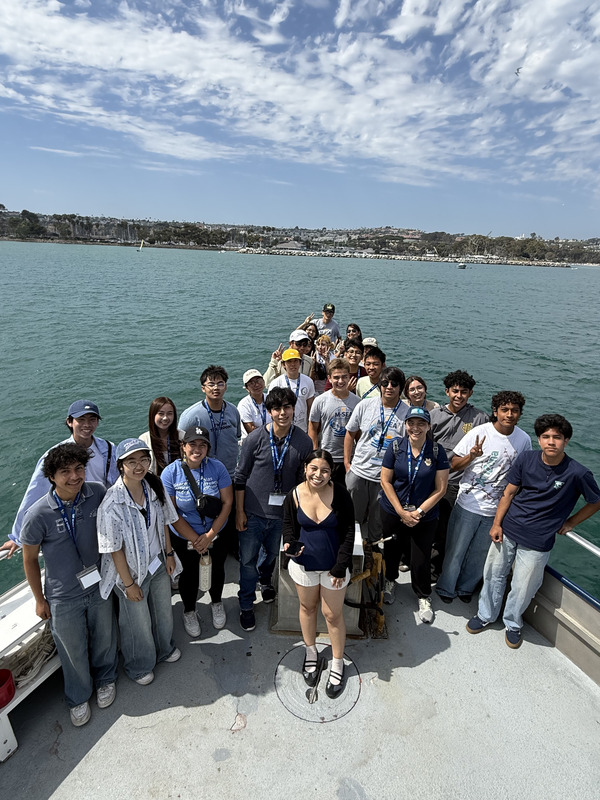
“I especially enjoyed the advanced floating lab on the R/V sea explorer and seeing dolphins, mahi mahi, plankton, and scorpion fish,” said Amy Voung, a Santiago High School senior. “Seeing dolphins in their natural habitat was really interesting!”
M-SEA is led by Mo Li, professor and chair of the Department of Civil and Environmental Engineering, together with Co-PI Analía Rao, executive director of the Stacey Nicholas Office of Outreach, Access and Inclusion (OAI).
“UCI brings expertise in advanced materials, robotics and coastal engineering, while the Ocean Institute brings the ocean itself, along with decades of leadership in marine science education,” Li said. “Together we can offer something neither of us could offer alone.”
The academy brought together high school students from nine Orange County High Schools - Anaheim, Fountain Valley, Los Amigos, Magnolia, Saddleback, Samueli Academy, Santa Ana, Santiago and Segerstrom - who are interested in STEM to learn from UCI professors and marine scientists at the Ocean Institute. Professor Mo Li taught them about ocean infrastructure. Dr. Efraín Méndez, a postdoctoral researcher working with former dean Magnus Egerstedt, introduced robotics and beach data monitoring. Brett Sanders, UCI Chancellor’s Professor of civil and environmental engineering, explained how waves and sand move on the beach. At the Ocean Institute, marine scientists walked them through El Niño and its effects on aquatic and land ecosystems, ocean acidification and coral bleaching, and bioaccumulation and how it affects food chains. The students also made and raced their own solar-powered robot cars.
The experience extended beyond the laboratory and the ocean. At UCI, students explored the campus, learned about the college admissions process, and connected with undergraduate and graduate students who shared their experiences, academic journeys and perspectives on studying engineering.
“We wanted students to leave M-SEA not only excited about what they had experienced, but with a greater sense of what is possible for their future,” Rao said. “Meaningful STEM experiences at this stage can shape how students see their own potential and the opportunities they choose to pursue.”
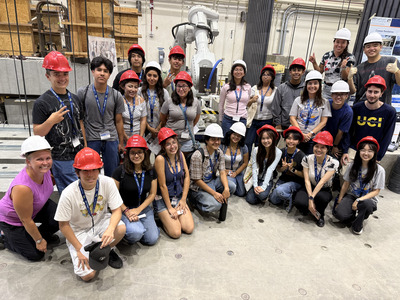
“Every day was like a new adventure,” said Julianne Dinh, a Santiago High School senior. “I learned how beach waves worked and why sand moves the way it does. I liked that there’s actually lots of physics and math related to it, which I didn’t know.”
“This program changed the way I think about engineering,” Dinh said. “Initially, I thought engineering was only building things. It really expanded my interest in engineering. It can actually relate to animals. I love animals a lot so I just found this program really fun.”
Many of the students cited the opportunity to view dolphins and fish in their natural habitat as one of the most memorable experiences of the program. “We got to see a lot of crazy stuff such as the stampede of dolphins!” said Daniel Fallon, a junior at the Samueli Academy. “I learned that ocean sciences have a direct correlation to engineering. It was really a pleasant surprise to see how they’re related.”
During a student panel, UCI students shared their experiences and resources available at UCI to support their interest in science and engineering. The connections students made at UCI also gave them an opportunity to learn more about the pathways and resources available to pursue their interests in STEM.
“I thought getting a Ph.D. was a little bit impossible financially, but a lot of the Ph.D. students helped me learn about the resources you can use,” said Jessica Estrada, a junior at Santiago High School. “I am excited to explore environmental engineering. I was going to study mechanical engineering but after this program, I definitely think this is a path I am more interested in.”
On the final day, students reflected on the week and shared what they had learned through group presentations. Their reflections demonstrated one of the academy’s central goals: expanding students’ understanding of marine science and engineering and helping them discover the connections between the two fields and the possibilities they offer.
“The program was really educational and engaging. It was super fun and showed me how truly expansive the engineering realm is,” said Vuong. “I originally thought that engineering was kind of linear, like you sit in an office, make blueprints and build creations, but you’re really not limited to anything when it comes to engineering.”
- Natalie Tso
